
KASHMIR THE PARADISE
SRINAGAR
The northern most state of the Indian mainland is rightly called “Paradise on Earth”. The sparkling rivers, placid lakes, gorgeous gardens and indescribable beauty of nature in the state of Jammu and Kashmir leave you completely speechless. Home to the unparalleled virgin landscapes of Kashmir, Leh and Ladakh, a travel and tourism experience to this joyous state is an unmatchable experience that will leave you feeling cleansed and pure.
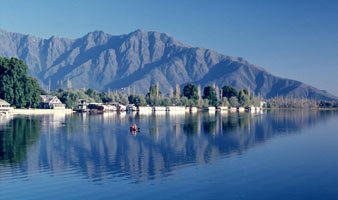
The City of Lakes, nestles in the heart of one of the loveliest areas of the country, the Kashmir Valley. Srinagar spreads out on the both sides of the river Jehlum. The Valley’s beauty has enticed visitors from distant lands. Srinagar bears hallmark of the Mughals, splendid formal gardens laid out by the Mughal emperors for their enjoyment are beautifully maintained. Houseboats on the lake – the British solution to the law that prevented them from owning property, are an exciting alternative to the more traditional hotels.
Srinagar is also a take-off point for some of the Kashmir’s hill stations and a base for a variety of activities that range from trekking and mountaineering to fishing, golf and skiing.
Srinagar city– A Journey Through Time
Origin and Ancient History of Srinagar
Present-day Srinagar traces its origins to Pandrethan (ancient Pranasthan), founded by Ashok. Historians still debate whether this was Ashoka the Great or a local ruler named Ashok from Kashmir. Over time, Pranasthan was linguistically transformed into Pandrethan.
Ancient scholars and travelers referred to the city by many names, including Shahre-Himawan, Parawarpor, Srinagar, and Shrinagar—the most enduring names meaning a beautiful, happy, and prosperous city.
Buddhist Era and Early Capitals
For nearly 800 years, Kashmir was ruled by different dynasties, during which prominent Vihars (monastic centers) were established. Important sites included Gopadari (modern Gupkar) and Harwan Vihar, extending from the New City areas to Wular parganas.
In the 6th century, due to population growth, rulers shifted the capital from Pandrethan to Pawarsianpor (Payrpora), though the city continued to be popularly known as Srinagar or Razdhani.
Lalitaditya and the Rise of New Capitals
During the reign of Lalitaditya, the capital moved to Parihaspora, reducing the political importance of Pandrethan and Parwar Port. Other regional capitals emerged, such as Anderkoot (Sumbal) under Jaipeda and Awantipora founded by King Awantivarman.
Medieval Srinagar and Urban Expansion
In the 9th century, King Shankar Varman ruled from Pattan, but Srinagar regained prominence under Khemgupta and Queen Dedrani, who developed the Dedmar and Bradimar areas.
Later, Raja Anant ruled from Srinagar, strengthening its status as a political center.
Sultanate Period and Islamic Influence
In 1323 AD, Rinchan founded Rinchanpur, followed by Allaudin, who established Allaudin Para near Hari Parbat. By 1400 AD, Badshah laid the foundation of Naw Shahar, marking a new phase in Srinagar’s urban history.
Mughal Era and the City of Gardens
The arrival of Emperor Akbar transformed Srinagar significantly. He developed Nagar Nagar, fortified Hari Parbat, and enhanced the importance of the Zabarwan Range overlooking Dal Lake. This era saw the creation of the iconic Mughal Gardens, which continue to define Srinagar’s landscape.
Sikh, Pathan, and Dogra Rule
After the Mughals, Pathan and Sikh rule shaped Srinagar due to its strategic central location. In 1846, Kashmir was sold, marking the beginning of Maharaja (Dogra) rule.
This period attracted European travelers, particularly along the left bank of the Jhelum River and the Bund area, as Europeans were restricted from mingling freely with local Kashmiris.
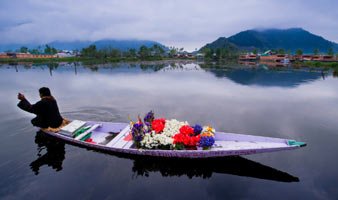
THE DAL LAKE
The Dal lake and river Jehlum is series of interconnected lakes and waterways make Srinagar a visula delight. The Lake is an intricate maze of waterways and open streches of water. They are delight to explore, especially in the little roofed boats called the Shikara’s. Within the lake are two islands which are popular picnic spots. Sona Lank ( Golden Island) and Rupa Lank (Silver Island) both are also known as Char Chinar because they each have four chinar trees on them planted by the Mughal Emperor Akbar.
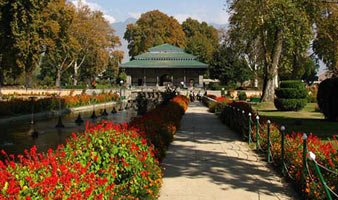
SHALIMAR GARDEN (ADOBE OF LOVE)
The splendid garden with fountains and a water channel was laid out by Emperor Jehangir for his wife, Nur Jahan ( Light of the World) in 1616and was extended in 1727 A.D by Shah Jehan, also known as “Abode of Love”. During the Mughal period the top-most of the four terraces were reserved for the Emperor and the ladies of the court.
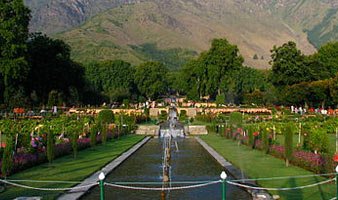
NISHAT BAGH (GARDEN OF PLEASURE)
The Nishat bagh has a superb view across the lake to the Pir Panjal. It was designed in 1633 by Asif Khan the brother of Nur Jahan. This “Garden of Bliss” with ten terraces has many carefully laid out flower beds and magnificent lawns and commands a magnificent view of the lake and snow capped Pir Panjal Mountain range which stands far away to the west of the valley.
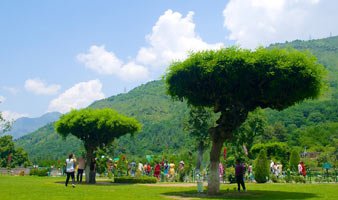
CHASHMA SHAHI
Chashma Shahi is smallest of all the Moughal gardens at Srinagar. The garden was laid in 1632 by Shah Jahan and build by Dara Shikon. Is is famous for the natural spring, the water has a property of high digestion . The people from various visit to cherish the natural water. The garden is terraced with fountains laid right through the middle. The garden is host to multiple kinds of fruit and flower plants.
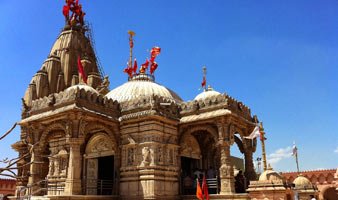
SHANKARACHARYA TEMPLE
It is located at 1100ft.above surface level of the main city on the Shankaracharya hill, also known as Takht-e-Suleiman. The shiva temple, as Kalhana belives, was constructed by Raja Gopadatya in 371 B.C.and as such is the oldest shirne in Kashmir. Dogra ruler,Maharaja Gulab Singh, constructed stone stairs upto the temple.
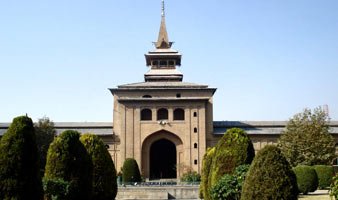
JAMIA MASJID
It is one of the oldest and the most spacious of all the mosques in Kashmir, situated in the heart of the city.The foundation of the mosque, an architectural wonder. This impressive wooden mosque is notable for the 300 plus pillars supporting the roof, each made of a single Deodar tree trunk. The present mosque, with its green and peaceful inner courtyard, was rebuilt to the original design after a fire in 1674.
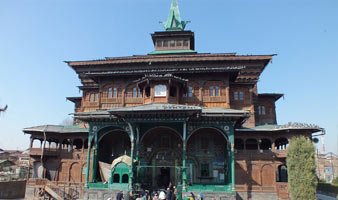
SHAH HAMDAN MOSQUE
The shrine of Shah-e-Hamdan or Khanqah-e-Moulla is one of the oldest muslim shrines in Kashmir situated on the bank of the river Jhelum in the old city. Originally built in 1395, the all wooden mosque was destroyed by fire in 1479 and 1731.has fine Papier Machie work on its walls and ceilings. The present Mosque is shaped like a cube with a Pyramidal roof rising to a spire and has fine Paiper Machie work on its walls and ceilings.
